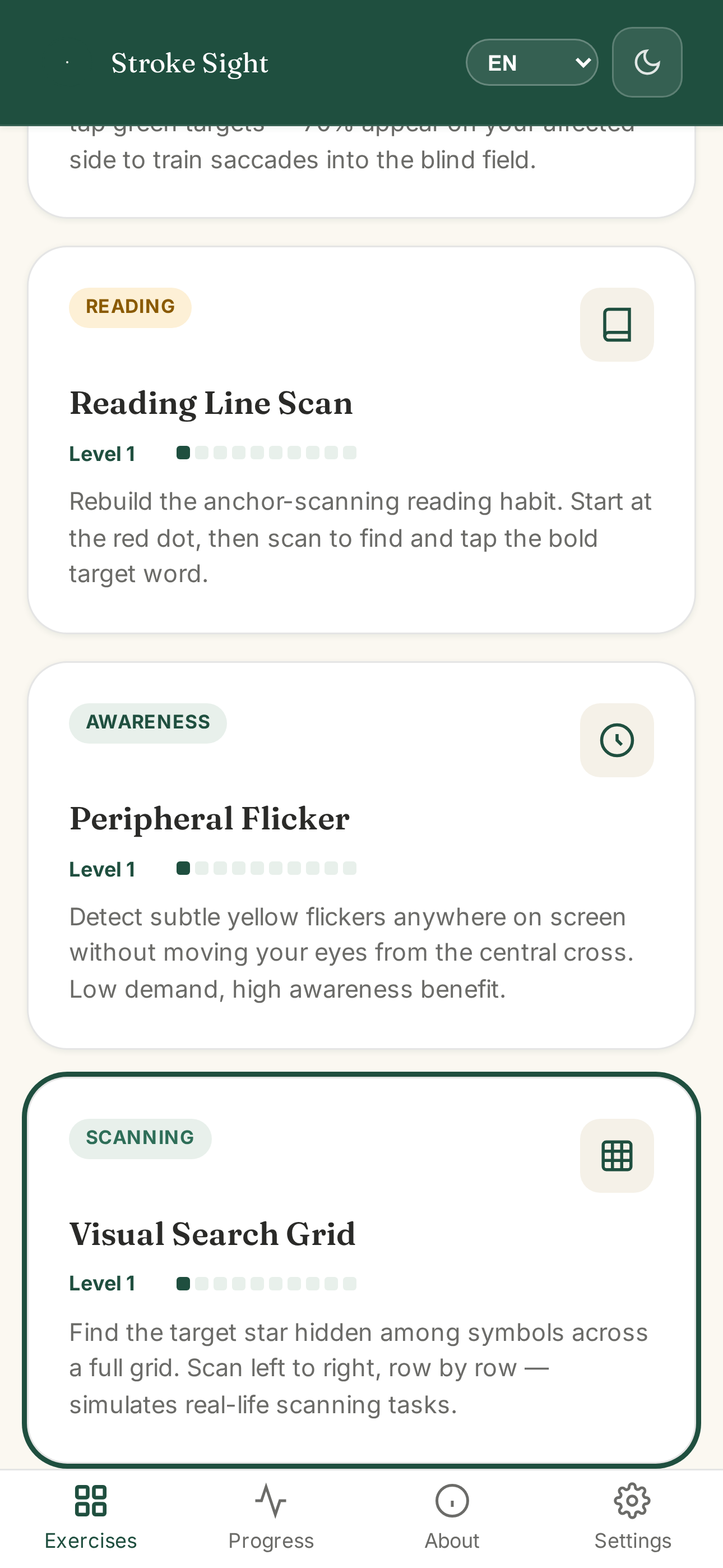
Eight evidence-based exercises for the four most common post-stroke visual and attentional conditions. Grounded in saccadic scanning and smooth pursuit training traditions. Aligned with NICE NG236 recommendations for eye movement therapy.
Aligned with NICE NG236
Each condition has a distinct clinical evidence base. The exercises are designed to match — not a single exercise template applied to different problems, but different therapeutic approaches for different needs.
Hemianopia, quadrantanopia, or scotoma — all four conditions are supported with condition-specific exercises
Difficulty noticing one side of space — the Smooth Pursuit and Line Bisection exercises target this directly
A structured tool for daily home practice between sessions, with progress reports you can review together
Something concrete to support rehabilitation without needing clinical training yourself
Evidence-based protocols suggest 15–30 minutes daily, at least 5 days per week, for 4–6 weeks. Two shorter sessions may be more effective than one longer session.
You may notice improvements in how confidently you scan your surroundings, how easily you track text while reading, or how quickly you spot things on your affected side. Some users see measurable changes within weeks; for others it takes longer. Consistency matters more than intensity.
Stroke Sight is a wellness support tool — not a medical device. It does not diagnose, treat, or cure any condition. Always follow the guidance of your neuro-optometrist, orthoptist, or rehabilitation team.
General brain-training apps target cognition broadly. They do not address the specific eye-movement patterns that visual field loss and spatial neglect disrupt. Stroke Sight uses different therapeutic approaches for different conditions — saccadic scanning for hemianopia, smooth pursuit for neglect, awareness training for scotoma — each grounded in its own published evidence base. That condition-specific design is what sets it apart.
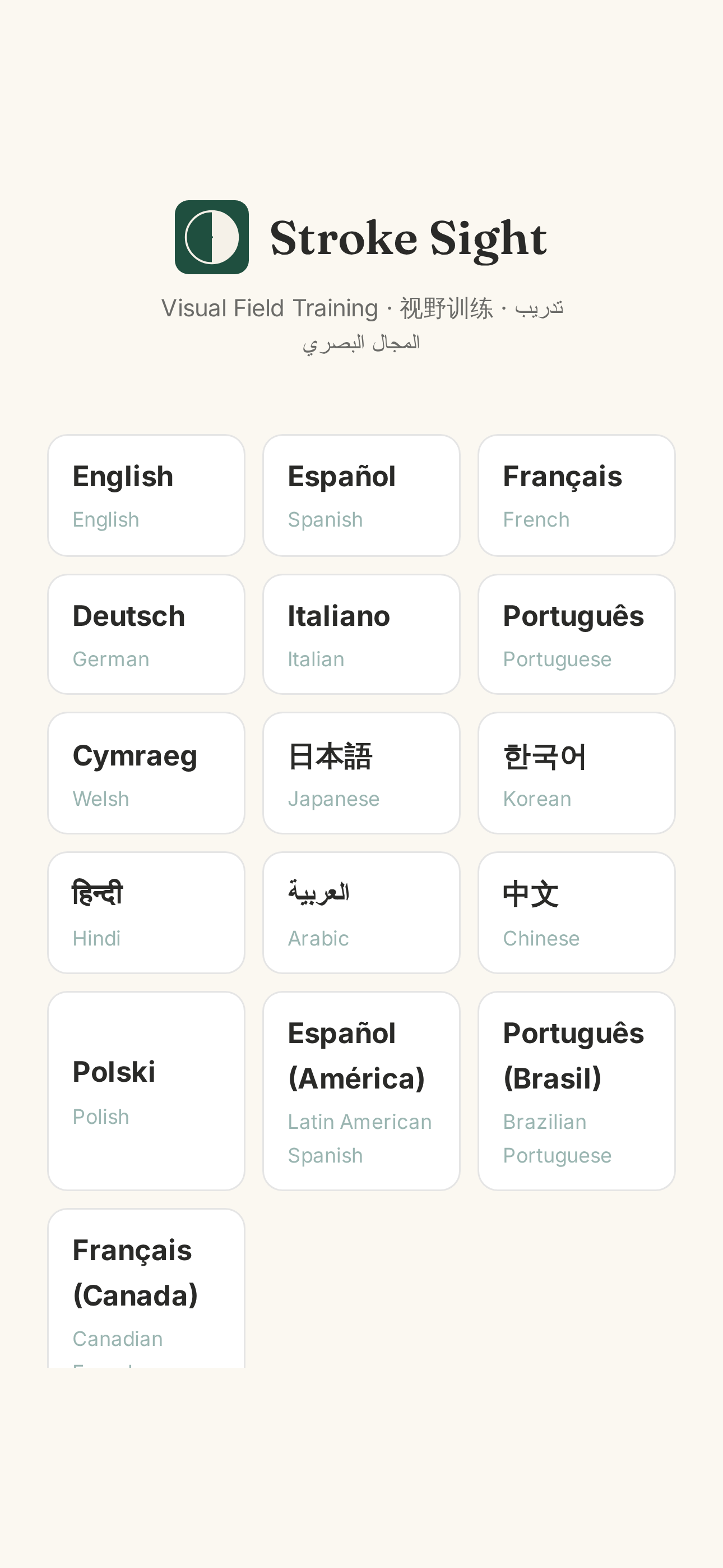
English, Spanish, French, German, Italian, Portuguese, Welsh, Japanese, Korean, Hindi, Arabic, Chinese, Polish, Latin American Spanish, Brazilian Portuguese, and Canadian French
Hemianopia, quadrantanopia, visual neglect and scotoma — each with condition-specific exercises
Start gently and increase challenge as you improve
Stereo sound that moves with visual targets, drawing on multisensory rehabilitation research (Bolognini, Tinelli)
Three-level audio toggle — off, subtle, prominent — for users with hyperacusis or auditory processing difficulties
Exercises adapt to left or right side at setup
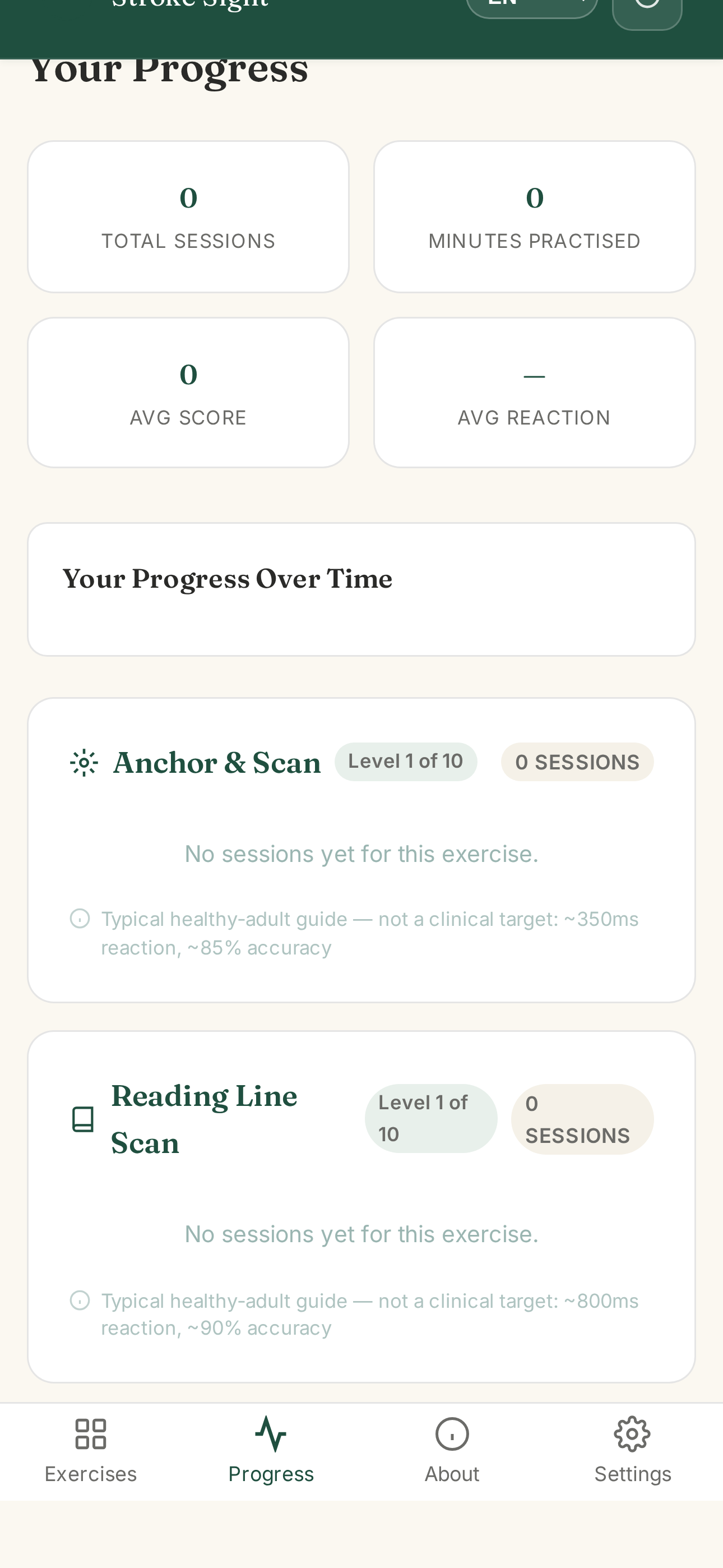
View your accuracy and reaction times over time
Share results with your therapist via email — uses your own mail app, no data leaves the device
No internet connection needed after download. Works on hospital wards, in care homes.
About 1 in 5 stroke survivors notice their colour vision is different. Three display modes — Standard, High Contrast Yellow, and High Contrast White — let you pick the one that works for your eyes.
Stroke Sight's exercises are grounded in techniques studied in published clinical research on visual rehabilitation after stroke:
The SEARCH trial (Rowe et al., 2025) found equivalent benefit from structured practice regardless of exercise specifics — supporting the value of consistent, daily engagement with any well-designed visual training programme.
No. Stroke Sight is a wellness support tool designed to complement professional rehabilitation. It does not diagnose, treat, or cure any condition. Always use it alongside guidance from your clinical team. Stop using it if symptoms worsen and speak to your rehabilitation team.
Stroke Sight covers four post-stroke visual and attentional conditions: hemianopia, quadrantanopia, visual neglect, and scotoma. When you first open the app, you choose your condition and which side is affected. Exercises then adapt accordingly.
Yes. The Smooth Pursuit exercise uses slow tracking toward the neglected side with spatial audio cues — the approach recommended by German Neurological Society guidelines and receiving the highest evidence grade in a 2015 systematic review.
Yes. When you first open the app, you choose which side is affected. All exercises then adapt to present targets in the appropriate direction.
10–15 minutes is ideal. The app recommends exercises based on your energy level when you open it. Short, consistent daily practice is more effective than occasional long sessions.
Yes — the app has an email progress report feature that generates a summary you can send to your therapist. It uses your device's own mail app, so no data is stored or processed by us.
Only for the initial download. After that, everything works offline — on hospital wards, in care homes, or anywhere without connectivity.
Stroke can change how colours are perceived. In Settings › Visual Display you can choose between Standard (green targets, yellow anchors), High Contrast Yellow, or High Contrast White. You can try all three in the free demo before you buy.
No. £29.99 one-time purchase. No subscription, no in-app purchases, no ads. You pay once, you own it.


Reviews and clinician feedback will appear here as they arrive. If you've used Stroke Sight and would like to share your experience, please get in touch.
A one-page evidence summary is available for circulation in clinical teams. If you are an occupational therapist, orthoptist, neuro-optometrist or stroke rehabilitation specialist, clinical feedback is welcomed at any time.