Evidence-based visual field and handwriting exercises for adults recovering from stroke and neurological injury. Designed to support daily practice alongside professional care.
Available in 17 languages including Welsh, Canadian French and Arabic — because after a stroke, practising in your first language matters.
Each app addresses a specific post-stroke difficulty — visual field loss and handwriting — with exercises grounded in published clinical research. Both work offline, collect no data, and sit quietly alongside the professional care already happening.
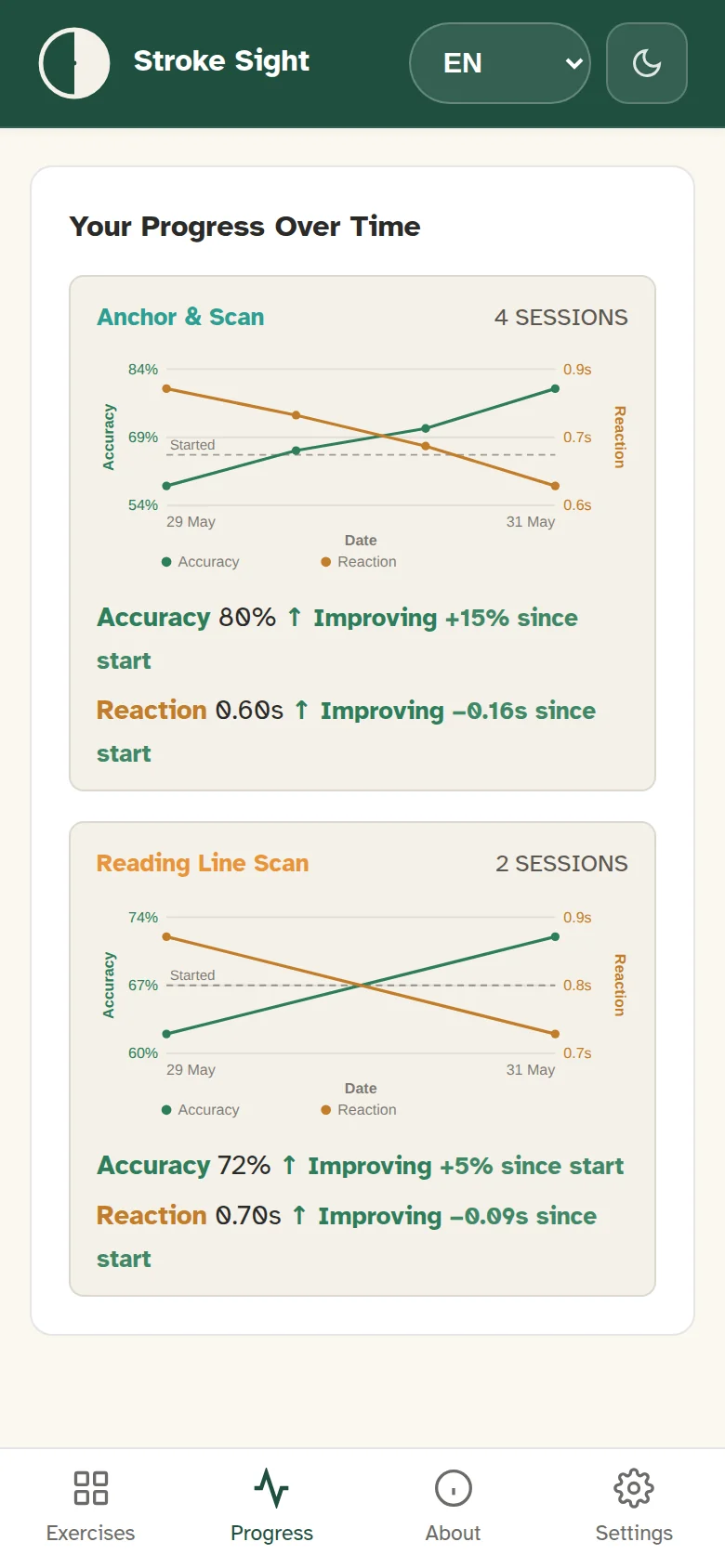
Eight evidence-based exercises covering hemianopia, quadrantanopia, visual neglect and scotoma. Ten adaptive difficulty levels. Grounded in the saccadic scanning and smooth pursuit training traditions supported by NICE NG236 and four decades of clinical research. Three colour modes for changed colour vision after stroke.
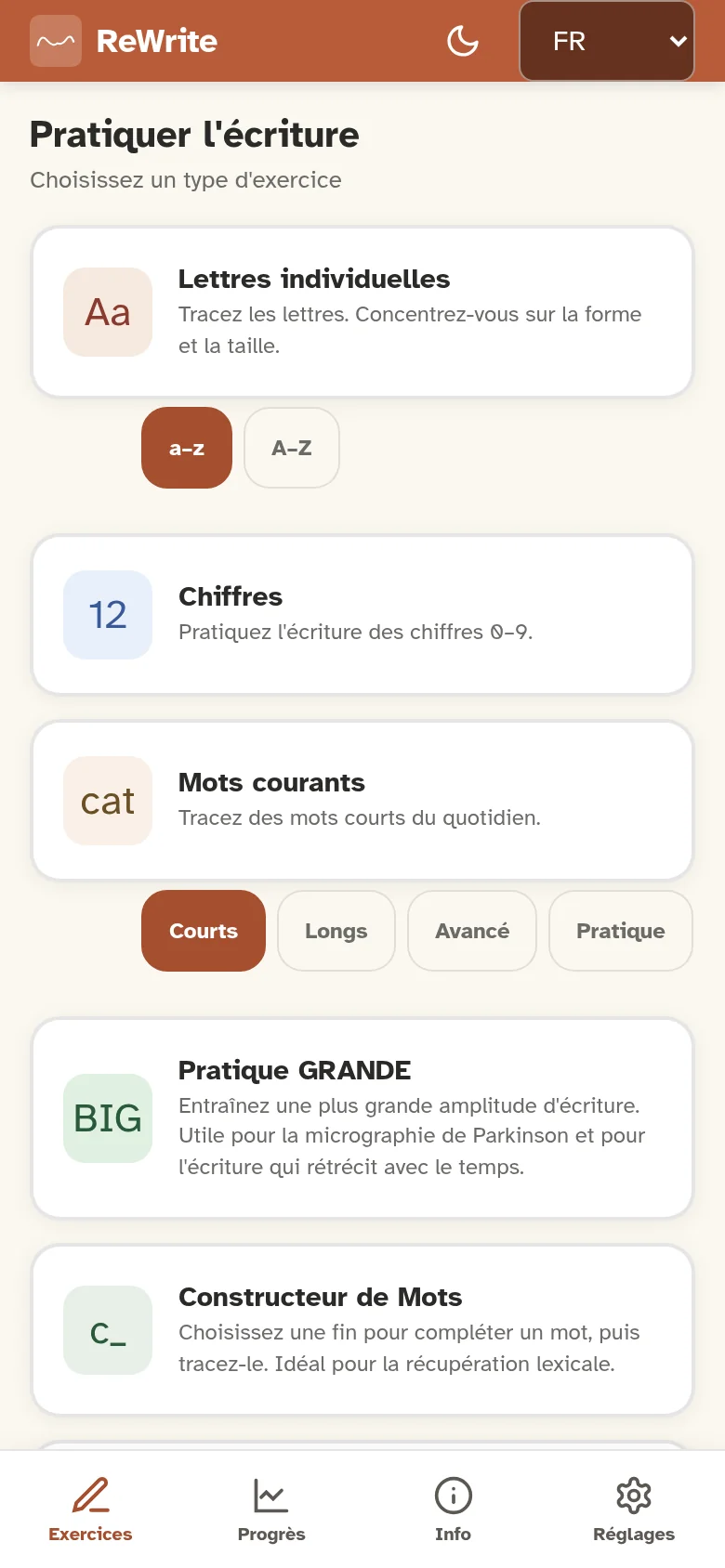
Guided tracing practice for letters, words and sentences — with language-specific content for Welsh, Arabic, Japanese kana, Korean hangul, Chinese characters and Hindi Devanagari. Post-stroke handwriting rehabilitation designed for how people actually write, not just in English.
These aren't wellness apps dressed up in clinical language. The exercises are drawn directly from decades of rehabilitation research, with approaches endorsed by national guidelines and systematic reviews.
Hemianopia exercises follow the compensatory saccadic scanning approach supported by NICE NG236 and four decades of research from Zihl, Kerkhoff, Pambakian and Trauzettel-Klosinski. The neglect exercises use smooth pursuit eye movement training — recommended by German Neurological Society guidelines and awarded the highest evidence grade in the Klinke et al. (2015) systematic review. Spatial auditory cues draw on the multisensory research of Bolognini and Tinelli.
Structured tracing practice using principles from the graphomotor rehabilitation literature, with language-specific content for scripts that matter to the learner — not just translated menus. Letter and word progression is graded by difficulty, and session length is designed around typical post-stroke fatigue windows.
These are wellness support tools — not medical devices. They complement, rather than replace, the care of your neuro-optometrist, stroke rehabilitation team, or occupational therapist. Always follow the guidance of your clinical team.
Language-specific letter sets for Welsh, Canadian French, Arabic, Japanese, Korean, Hindi, Chinese and more. Not just translated menus.
Grounded in published rehabilitation research naming Zihl, Kerkhoff, Pambakian, Trauzettel-Klosinski, Bolognini, Tinelli and Klinke.
No internet connection required after first save. Nothing depends on our servers.
All progress stays on your device. No accounts, no analytics, no tracking.
Anstey Apps was founded in 2026 after a loved one had a stroke that caused significant vision loss. What we found during her rehabilitation is that good digital tools existed, but they were limited — and tended to treat one stroke symptom in isolation.
They were also all in English, or one additional language. These apps exist to fill that gap. They are built on published clinical research, cover the most common post-stroke visual and handwriting difficulties, and work in sixteen languages — with real language-specific content, not just translated menus.
Built in the UK, by a family dealing with stroke, for others dealing with stroke and its aftermath.
— Liam Anstey, founder
If you are an occupational therapist, speech and language therapist, neuro-optometrist, orthoptist, or stroke rehabilitation specialist, a one-page evidence summary is available for circulation in clinical teams. Clinical feedback is welcomed at any time — these tools are built to complement your work and improve with your input.
Whether you're a clinician considering recommending the apps, a commissioner exploring institutional licensing, a journalist writing about stroke recovery, or a stroke survivor with a question — I read every email personally.